RoofMan Official Blog
"If we teach today as we taught yesterday, we rob our children of tomorrow."

CareFabric
CAREFABRIC · Overview & impact / Architecture / Explore & connect
Exploring architecture as code with AI
Connect the patient journey. Keep records local.
I developed CareFabric while studying architecture as code with AI. Healthcare interoperability gave me a practical problem to explore: how could different organizations share useful clinical context while keeping responsibility for their own records?
I’m releasing this blueprint to share the thinking, diagrams and trade-offs that came out of that work. If you find the idea interesting, have a different perspective or see a connection to something you’re working on, I’d be glad to hear from you.
The proposed design connects clinical handoffs across existing systems. It coordinates trust and access while each organization keeps custody of its clinical records.

Project status: an architecture proposal with illustrative interface concepts. The benefits described here are objectives to evaluate in a deployment; they are not measured CareFabric production results.
The idea in one minute
- Keep records local. Hospitals and partners continue to operate their own clinical systems.
- Give each participant a governed boundary. A PeerNode handles local integration, identity mapping, access enforcement and audit.
- Coordinate the rules. A shared Trust Authority manages participation, policy, discovery and audit intake.
- Start with one useful handoff. Prove the workflow, operational ownership and safety controls before expanding.
The contribution is a practical operating contract around existing standards: who may exchange what, for which purpose, under whose responsibility, and with what evidence.
With the right care and reporting workflows, this foundation could also help reduce avoidable crowding in clinics and hospitals and support pandemic preparedness and control.
- Start with the patient journey
- Relieve crowding and support pandemic control
- Explore the architecture
- Explore further and connect
Start with the patient journey
The problem I wanted to explore was the gap between capable local systems and a patient journey that crossed organizational boundaries. Phone calls, repeated questions, manual exports and re-entry often become the bridge between those systems.
The pressure is familiar after an acquisition, across branches with different electronic medical record systems, or whenever a clinic depends on an external laboratory. An interface may exist, yet nobody owns the complete handoff: patient identity, permission to share, the receiving workflow, failures and follow-up.
One encounter, several sources
Consider a fictional patient visiting a clinic away from her usual provider. The clinician needs recent laboratory results, medication history and an imaging report held elsewhere. Those records may inform care; the clinician still decides whether they are relevant, sufficiently current and complete.
Today: reconstruct the context
Staff identify likely providers, request records, follow up and reconcile what arrives. Missing or delayed context consumes attention during the encounter.
With the proposed fabric: request it deliberately
The clinic verifies identity, discovers eligible sources, obtains scoped authorization and retrieves approved content into its local workflow. Exceptions enter a visible review queue.
The useful outcome is a more dependable handoff: the right source, the right patient, an explicit reason for access and an explanation when the answer is no. Claims about reduced testing, cost or clinical risk need to be established through evaluation rather than assumed from a diagram.
Follow the seven-step patient journey
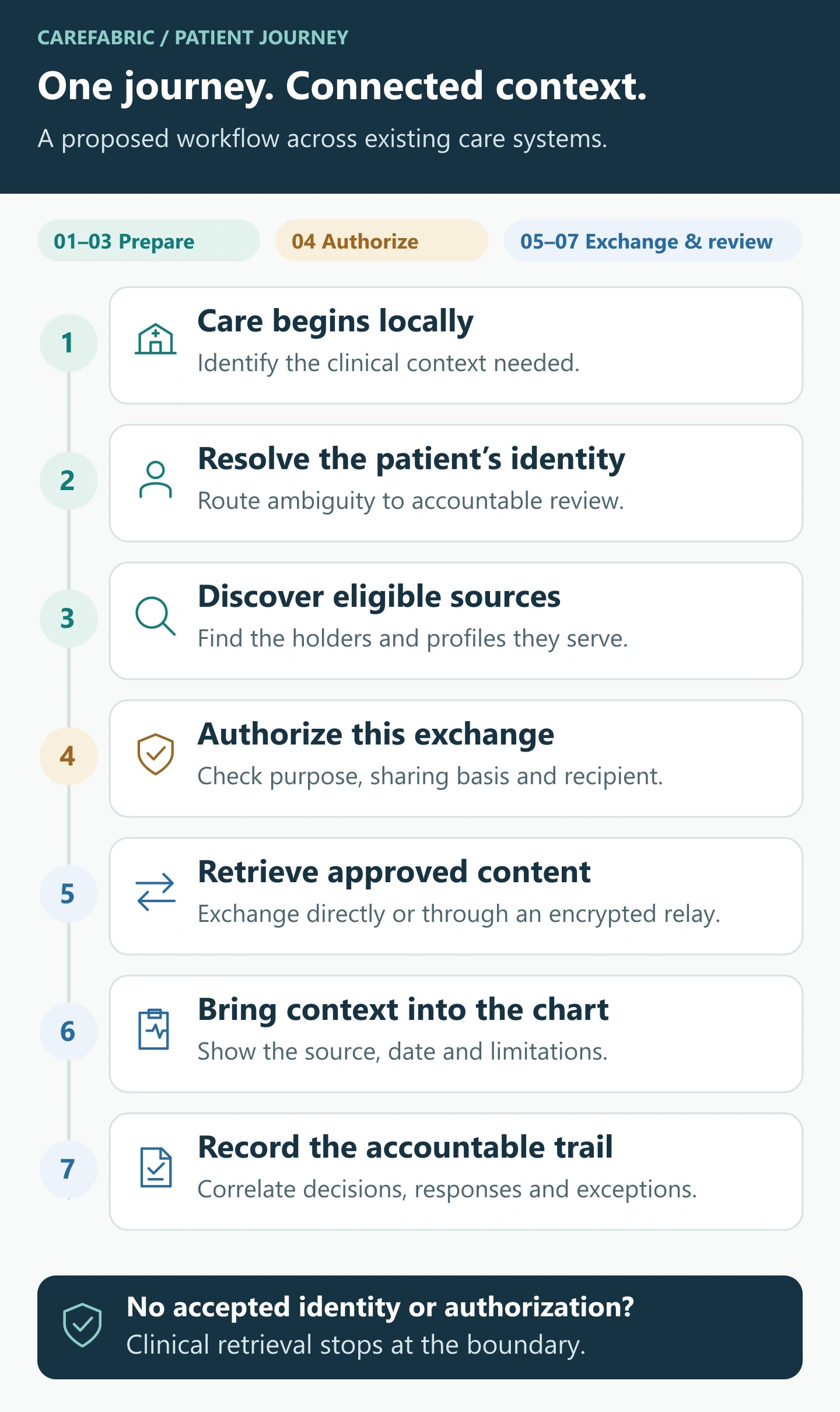
- Local encounter: the requesting clinician identifies the context needed.
- Identity: resolve the correct patient or route ambiguity to review.
- Discovery: identify eligible holders and the data profiles they serve.
- Authorization: evaluate the purpose, sharing basis, recipient and route.
- Retrieval: exchange approved content between the relevant PeerNodes.
- Presentation: show source, timestamp and limitations in the receiving workflow.
- Accountability: correlate records of the request, decision and response at both ends.
Relieve crowding and support pandemic control
Interoperability can contribute beyond the individual handoff. The opportunity is to move information promptly so that people and response teams can act at the appropriate place and time. For CareFabric, the following are proposed impact pathways, not proven deployment outcomes.
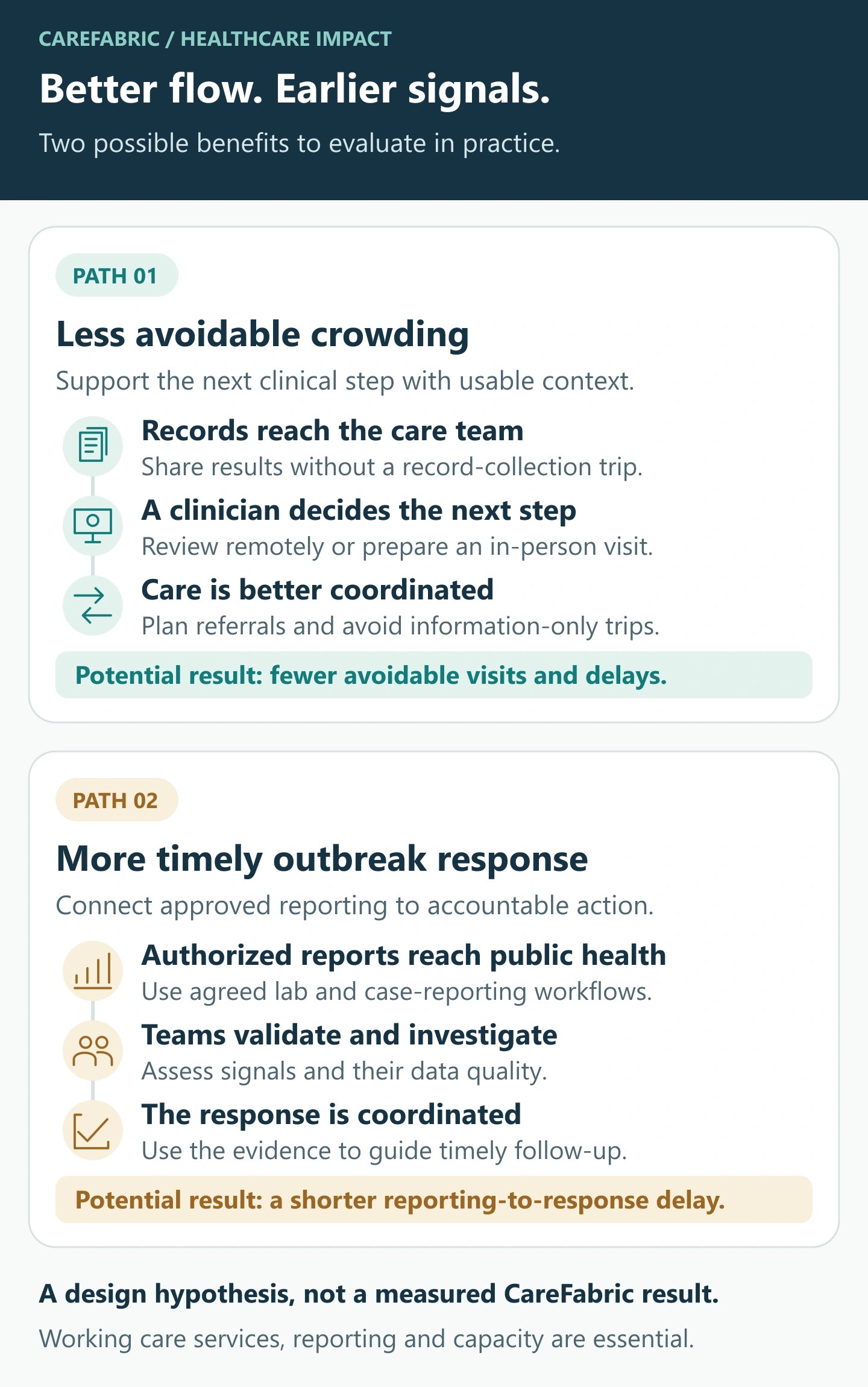
Less avoidable congestion in clinics and hospitals
- Let records travel. Deliver a usable result or discharge summary to the receiving team, reducing the need for a patient to visit another facility simply to collect or carry information.
- Support appropriate remote follow-up. Give an authorized clinician the context needed to decide whether a result review can happen remotely or needs an in-person assessment. This requires a separately designed telemedicine and escalation workflow.
- Make referrals better prepared. Share relevant context before arrival and coordinate with booking or capacity systems where those integrations exist. Teams may spend less time chasing paperwork or repeating an investigation solely because its usable result is unavailable.
For example, a clinician might review an external laboratory result during a planned remote follow-up, avoiding a trip made only to transfer the report. A patient who needs examination or urgent care still needs the appropriate clinical pathway. WHO’s telemedicine implementation guide describes potential benefits including fewer unnecessary clinical visits; applying that benefit to CareFabric depends on delivering and evaluating the surrounding service.
A foundation for pandemic preparedness and control
During an outbreak, agreed lab and case-reporting interfaces could help authorized public-health teams receive timely, standardized information from participating sites. Those teams can validate signals, investigate unusual patterns and coordinate follow-up. This is consistent with the early-warning and intervention-monitoring purposes of public-health surveillance described by WHO.
A reporting deployment could also combine approved activity summaries with separately integrated facility-capacity feeds to inform surge planning. Clinical record exchange alone does not provide a live bed-management system. Earlier reporting can support pandemic control when it leads to timely, effective action; it does not establish that the platform itself reduces transmission.
Design public-health reporting as an explicit extension. Agree the reporting purpose, authorized recipients, required fields, case definitions, identifiers, retention and correction process. Use aggregate information where sufficient; identifiable case reporting needs its own approved authority and access rules. Treatment access must not silently become permission for population surveillance.
The operational aim is fewer avoidable physical visits and a shorter path from a report to an accountable response. Staffing, capacity, infection prevention and accessible care remain essential. WHO’s digital-health guidance emphasizes that technology cannot substitute for functioning health services.
If the idea resonates, let’s talk
I’m sharing CareFabric as part of my learning and exploration. If you like the blueprint, have feedback or want to explore an idea together, I’d be happy to connect.

