
CareFabric: A Blueprint for Healthcare Interoperability
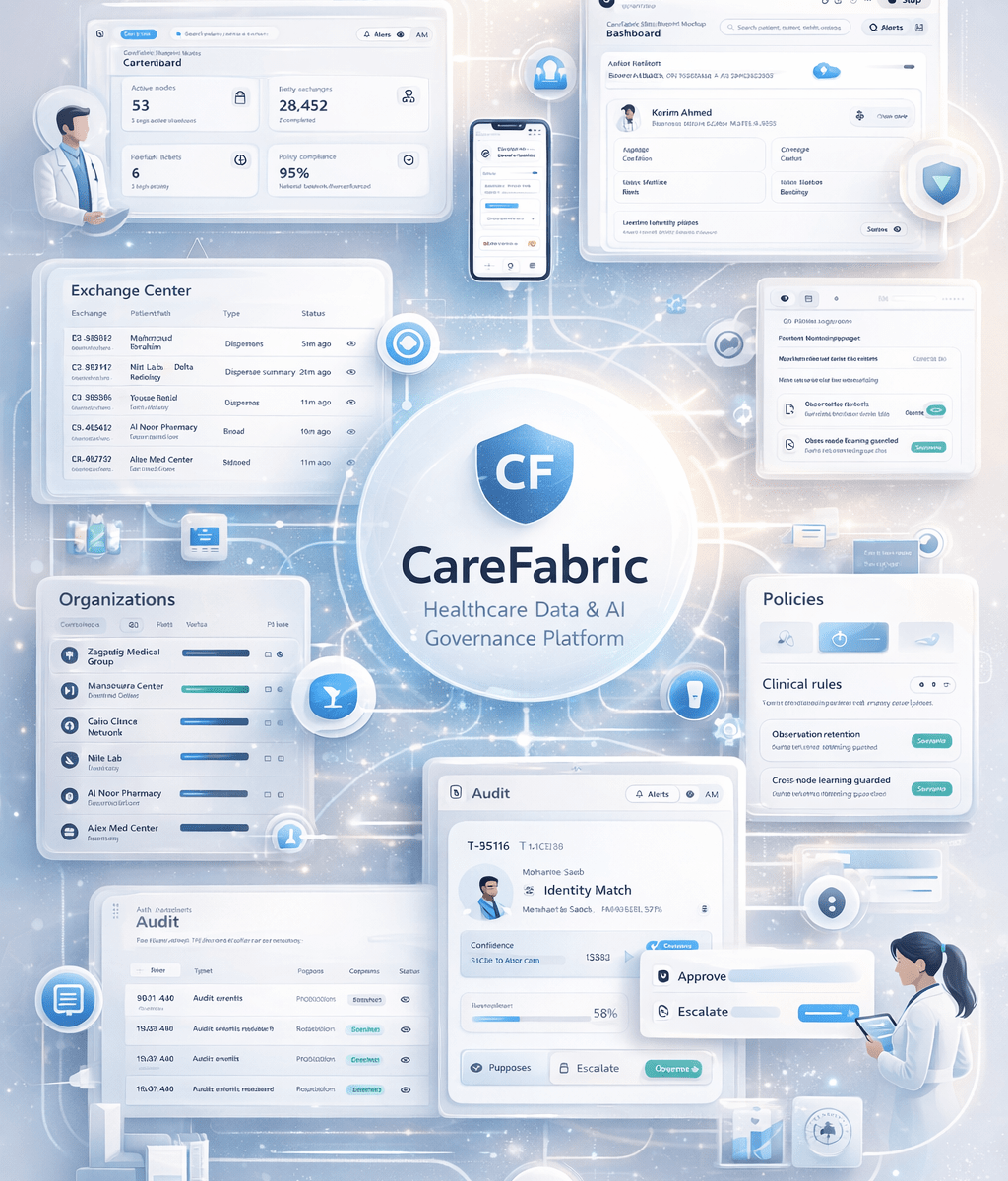
For around four years, I have been inside the medical field closely enough to understand how the current systems actually work, where they help, and where they repeatedly fall short. During that time, I was not only looking at software from a distance. I was watching how information moves across real workflows, how organizations coordinate, how fragmentation slows care, and how much effort is spent compensating for disconnected systems. After enough work and surveying, I modeled what I call CareFabric. The idea behind it is not new in the absolute sense, because healthcare interoperability has been discussed and implemented in different forms for years. What I believe is different here is the approach: treating national clinical exchange as a trust, governance, discovery, and operating model, not merely as another integration exercise. That distinction matters because the global direction of interoperability has already shown that frameworks, not just interfaces, are what make large-scale exchange workable. TEFCA in the United States is one clear example of that shift toward a nationwide framework for trusted health information sharing. (ONC)
The core problem is not that healthcare lacks systems. In most environments, there are already many systems. Hospitals have their own platforms. Clinics have their own workflows. Laboratories, pharmacies, radiology centers, and specialty providers all have their own software boundaries. The real issue is that the patient journey does not stay inside those boundaries. One organization may hold the appointment, another the clinical note, another the latest lab result, another the medication dispense history, and another the report that changes the treatment decision. HL7’s FHIR overview describes this challenge directly: as patients move across the healthcare ecosystem, their records need to be available, discoverable, understandable, and structured enough for safe machine processing. (HL7)
That is why I do not see CareFabric as another hospital system, another EMR, or another central platform that tries to absorb everything. I see it as a blueprint for sovereign federated clinical exchange. In this blueprint, government is not necessarily the permanent owner of all clinical content. Instead, government becomes the trust tracker. It provides the national control layer: participation rules, policy authority, endpoint registry, certification, audit intake, and exchange coordination. Healthcare organizations remain the custodians of the actual records and participate as trusted nodes in a national exchange fabric. This is much closer to the logic behind modern health information sharing frameworks than to the old instinct of solving interoperability with one giant system. TEFCA, for example, explicitly positions itself as a nationwide framework and a network-of-networks approach rather than as a single national record application. (ONC)
This separation between trust and custody is the intellectual center of CareFabric. I believe that many national interoperability discussions get trapped between two weak extremes. The first is fragmentation, where every organization builds isolated point-to-point integrations and the ecosystem becomes difficult to govern. The second is over-centralization, where the state or a single platform becomes the permanent holder of all clinical data, introducing concentration risk, political resistance, and operational overload. CareFabric is my attempt to define a third path. Trust can be coordinated centrally. Policy can be defined nationally. Audit can be collected at the ecosystem level. Discovery can be enabled through shared metadata. But the actual clinical records can remain primarily with the organizations that generate and manage them. That makes the model more realistic for a country that wants interoperability without making every byte of patient data centrally owned.
Another important design decision is scope. CareFabric should not become a billing network. It should not become a reimbursement platform, a claims switch, or a settlement engine. The moment financial flows become central to the architecture, the platform begins to serve different incentives and attract different forms of complexity. I intentionally model it as a clinical coordination fabric, not a financial one. Its focus should be on patient summaries, appointments, referrals, medication and dispense information, lab results, radiology reports, and continuity-of-care data. By keeping billing and financial exchange out of scope, the blueprint stays clinically meaningful and politically cleaner.
From a structural point of view, CareFabric works through two major layers. The first is a national control plane. This is where the government role lives. It manages participant trust, node enrollment, policy publication, endpoint discovery, metadata indexing, and audit oversight. The second is a federated data plane. This is where organizations actually exchange approved clinical information with one another. One hospital, clinic, lab, or pharmacy does not need to surrender its records into a central warehouse in order to participate. Instead, it exposes only what it is allowed and willing to share inside the national framework. That architecture fits very naturally with Zero Trust thinking. NIST’s Zero Trust Architecture makes the principle clear: there is no implicit trust based on network location or ownership; authentication and authorization must be explicit before access is granted. That is exactly how a national clinical exchange should think. (NIST)
A blueprint like this only becomes useful if it solves discovery properly. Exchange is not enough on its own. Before an organization can request something meaningful, it needs to know whether relevant data exists somewhere in the network, what type of data it is, and which organization holds it. This is where I see CareFabric needing a patient-aware metadata and locator layer. The system should not centrally hold all content, but it should centrally maintain enough metadata to answer questions like: which trusted organizations may have relevant information for this patient, what class of information is it, and how recent is it? That is much closer to a record locator and metadata index than to a national chart repository. For document-style workflows, IHE MHD is especially relevant because it is built around discovering and retrieving documents through metadata rather than blind exchange. (HL7)
This discovery model is important because healthcare exchange is not the same as file sharing. The right analogy is not “who has the file?” but “who may have clinically relevant information about this patient, and under what purpose can that information be requested?” That difference changes the whole architecture. It turns the network from a transport mesh into a governed clinical directory.
Patient identity is another foundational layer that cannot be treated casually. Any national exchange model lives or dies by how well it can establish who the patient is across different organizations and systems. CareFabric therefore needs a patient reference strategy that combines local identifiers, cross-system mapping, and national identity anchors where available. This is not the kind of problem that can be left to loose heuristics and hope. If the wrong patient is matched, everything else in the exchange loses meaning.
On the technical side, I believe the correct principle is custom protocol, standard foundations. CareFabric can define its own application semantics: its own message envelopes, policy claims, locator metadata, audit events, and node lifecycle behaviors. But it should not invent its own cryptography or ignore established interoperability standards. FHIR should be the structured data backbone because it already exists to exchange healthcare information electronically and to make that information discoverable and understandable across systems. SMART Backend Services is a useful model for secure system-to-system authorization to FHIR resources. And Zero Trust should be the security posture that governs access across the whole ecosystem. (HL7)
Real infrastructure conditions also matter. Many healthcare organizations operate behind firewalls, private networks, and restrictive routing. Some have no public static IPs. Some should never expose inbound services directly to the public internet. So CareFabric cannot be designed only for ideal network conditions. The practical model is that each participating node maintains an outbound secure control connection to the national tracker. The tracker handles rendezvous, trust coordination, and endpoint discovery. If two organizations can establish a direct secure connection, they do so. If they cannot, a sovereign relay service can assist the transport path without changing the trust model. That makes the system more realistic for actual hospital infrastructure while preserving the federated design.
AI belongs in this blueprint, but only within firm boundaries. I do not see AI as a hidden authority making silent national decisions. I see it as an operational assistant that should run on local or sovereign infrastructure only. It can help summarize records into approved exchange profiles, classify documents, suggest patient matches, flag gaps, and reduce manual work around preparing continuity-of-care information. What it should not do is override policy, merge identities without review, or act as a substitute for governance. NIST’s AI Risk Management Framework is clear that trustworthy AI requires governance, accountability, and lifecycle control, which is exactly the posture a medical system like this needs. (NIST)
This becomes even more important when AI is tied to human operations. In my view, CareFabric should include an AI-supported ticketing and review subsystem. AI can propose matches, summaries, classifications, or data preparation actions. But when confidence is low or the stakes are high, those proposals should become tickets for trained operators. Reviewers approve, reject, or correct the action, and the outcome becomes governed learning rather than hidden behavior. This keeps humans in control of the exceptions, keeps AI visible, and lets the system improve without turning raw automation into unaccountable truth.
Another principle I consider essential is organizational control over sharing. A national exchange cannot be built on the assumption that every participant will reveal everything to everyone. But it also cannot work if each organization shares so little that the network becomes clinically useless. CareFabric therefore depends on a layered policy model. The government defines the baseline: what data classes are in scope, what minimum participation obligations exist, and what categories are prohibited. Each organization then configures its own sharing behavior within that framework. That preserves institutional autonomy without collapsing interoperability.
For healthcare leaders, the value of CareFabric is not that it introduces a completely unprecedented concept. Its value is that it offers a more workable shape for a familiar problem. We already know interoperability matters. We already know the patient journey is distributed. We already know national trust frameworks are more effective than isolated technical interfaces alone. What CareFabric tries to do is bring those realities together into a clearer operating model: government manages trust, policy, audit, and discovery; organizations retain custody; exchange is selective; standards remain central; AI stays sovereign; finance stays out of scope.
That does not make the blueprint easy. It makes it serious. A design like this is more complex to govern than a single central application. It requires strong onboarding, a credible trust authority, disciplined identity management, reliable endpoint operations, a national metadata strategy, and sustained policy oversight. It also requires institutional confidence. If providers do not trust the governance model, or if the participation baseline is too weak, the network will not deliver its intended value no matter how elegant the architecture looks.
That is why I am sharing CareFabric as a blueprint, not as a startup launch or a promise that one team should go build a national system alone. Some ideas are worth documenting because they offer a better structure for future decisions. After around four years in the medical field, studying both the practical workflows and the system limitations, this is the structure I arrived at. Not because the industry has no interoperability ideas, but because I believe it still needs better shapes for trust, custody, sovereignty, and clinical coordination.
CareFabric is my attempt to define one of those shapes.
It is not an argument for one more healthcare platform. It is an argument for a better national form for clinical exchange.
Organization Node
Organization Node is the local CareFabric unit that runs inside each participating organization, like a hospital, clinic, lab, pharmacy, or radiology center.
It is the organization’s gateway to the CareFabric network.
Instead of exposing the hospital system directly to the national exchange, the organization installs a node that sits between:
- the organization’s internal systems
- and the external CareFabric ecosystem
So the node becomes the controlled boundary for trust, policy, exchange, audit, and AI-assisted review.
In simple terms
If CareFabric is the national fabric, the Organization Node is the organization’s personal port into that fabric.
A hospital does not send its EMR database directly.
A lab does not expose its LIS directly.
A pharmacy does not let outside parties query its raw system directly.
The node does that work safely on their behalf.
What it does
The Organization Node usually handles these responsibilities:
1. Receive and send exchange requests
It communicates with other trusted organizations through CareFabric.
2. Connect to local systems
It reads from internal systems like:
- EMR / HIS
- LIS
- RIS / PACS
- pharmacy systems
- appointment systems
3. Apply local sharing policy
The node decides what this organization is willing and allowed to share under the national rules.
4. Map data into exchange format
It converts internal data into the standard format used by CareFabric, such as clinical summaries, lab results, dispense history, and reports.
5. Resolve patient identity locally
It helps match the organization’s internal patient IDs to the wider CareFabric patient reference.
6. Create audit records
Every request, response, approval, and rejection should be logged.
7. Support AI and ticket review
If AI is used to summarize, classify, or suggest matches, the node can open review tickets for operators when confidence is low.
Why it is important
The Organization Node is what makes the architecture federated instead of centralized.
Without it, you usually end up with one of two bad models:
- direct messy integrations between every organization
- or a giant central system trying to own everything
The node avoids both.
It lets each organization:
- keep its own systems
- keep custody of its own records
- choose what to share
- participate in the national exchange in a controlled way
What it is not
The Organization Node is not:
- the hospital EMR itself
- a national central database
- just a proxy server
- only an API gateway
It is broader than that. It is a governed exchange boundary.
Internal parts of the node
A strong Organization Node usually contains:
- Exchange Gateway
receives and sends CareFabric requests - Policy Engine
checks whether a request is allowed - FHIR / Data Adapter
transforms local data into exchangeable format - Document Adapter
handles files and reports - Patient Identity Crosswalk
maps internal patient IDs to shared patient references - Audit Store
logs what happened - AI Assistant
supports summarization, classification, and matching suggestions - Ticketing / Review Hub
lets operators review uncertain AI outcomes
Example
A clinic opens a patient file and asks for recent external data.
The clinic’s Organization Node:
- receives the request from the clinic system
- checks the patient identity
- asks CareFabric where relevant data may exist
- requests allowed data from a lab node and pharmacy node
- filters the response according to policy
- returns the approved summary to the clinic system
- writes audit logs
- opens a ticket if something is ambiguous
So the clinic system itself stays simple.
The node handles the interoperability complexity.
Patient Identity in a Federated Healthcare Network
CareFabric depends on trust, and trust in healthcare exchange begins with patient identity. If two organizations cannot determine with enough confidence that they are referring to the same person, then even the most advanced interoperability layer becomes dangerous. A federated network cannot rely on identity as an afterthought. It must treat patient matching as a first-class architectural concern.
CareFabric uses a layered identity model rather than a single rigid mechanism. It does not assume that every country, provider, or care setting can depend on one universal identifier alone, and it does not leave matching entirely to local guesswork. Instead, identity is resolved through multiple levels of assurance. At the highest level, deterministic anchors may be used where national identifiers, verified insurance IDs, passport numbers, or other regulated identifiers are legally permitted and reliably available. At the second level, organizations exchange structured demographic attributes such as full name, date of birth, gender, phone numbers, and address history. At the third level, the network supports probabilistic matching, where trusted algorithms calculate confidence scores based on similarity across multiple attributes.
This creates a practical balance between national coordination and local autonomy. CareFabric does not require a fully centralized national medical record, but it does require a national identity trust framework. Each organization keeps its own patient master and local identifiers, while maintaining a crosswalk layer that maps internal identities to shared exchange references. The government or national authority may operate a national MPI, but even when such an MPI exists, it should function as a trust and resolution service, not as the owner of the clinical record itself.
Not every match should be treated equally. CareFabric classifies identity matches by assurance level. High-confidence deterministic matches may allow direct automated exchange. Medium-confidence probabilistic matches may allow metadata discovery but require organizational review before clinical retrieval. Low-confidence matches must not trigger automatic sharing at all. In these cases, the system opens a human review workflow, where trained staff validate identity before any sensitive data moves across the network.
This approach makes identity safer and more realistic. Healthcare systems are messy. Names change. Addresses change. Demographics are entered inconsistently. Some patients lack national identifiers, while others appear in multiple systems with partial or conflicting data. A real interoperability fabric must accept this reality. The answer is not blind centralization and not blind decentralization. The answer is controlled identity resolution with measurable confidence, explicit policy, and human escalation when certainty is not enough.
In CareFabric, patient identity is therefore not a single database field. It is a governed capability composed of deterministic anchors, probabilistic matching, local crosswalks, national trust rules, and review workflows. This is what allows the network to remain federated without becoming fragmented, and connected without becoming reckless.
Governance Envelope, Not Another Protocol
CareFabric should not be understood as a new healthcare exchange protocol. The healthcare industry already has too many partial frameworks, overlapping transport models, and local variations. Adding one more broad custom protocol would increase the very fragmentation the blueprint is trying to solve. FHIR already provides the core standard for exchanging healthcare information electronically, SMART Backend Services already defines how autonomous system clients obtain authorized access to FHIR servers, and IHE MHD already provides a FHIR-based model for document sharing and metadata-driven exchange.
For that reason, CareFabric is better defined as a governance envelope and node behavior model built on top of existing standards. Its role is to define how organizations join the network, how trust is established, how policies are enforced, how discovery is performed, how audit is reported, and how human review is triggered when confidence is not sufficient. The fabric governs behavior across nodes; it does not replace the standards those nodes already use for clinical data exchange.
In practice, this means CareFabric should publish national or ecosystem-specific implementation profiles rather than inventing a new stack. Structured data exchange can remain FHIR-based. System-to-system authorization can remain SMART-based. Document discovery and retrieval can remain MHD-based where document workflows are needed. What CareFabric adds is the shared rulebook: identity assurance levels, consent enforcement, purpose-of-use constraints, trust onboarding, certification requirements, audit obligations, and escalation paths for ambiguous cases.
What Integration Data Actually Looks Like
Interoperability becomes easier to trust when it stops sounding abstract. The real question is not whether organizations can “connect,” but what they actually exchange, how much they share, and what remains under local control. In CareFabric, the goal is not to dump full databases across institutions. The goal is to exchange the smallest useful clinical truth for a permitted purpose.
A hospital may first discover that another provider has data for a patient without immediately seeing the full contents. At this stage, the exchange is mostly metadata: what kind of record exists, when it was created, which organization owns it, and whether policy allows retrieval. This keeps discovery lightweight and reduces unnecessary exposure.
For example, an organization might publish a document entry that says a discharge summary exists, without exposing the document body until a valid request is approved:
---
resourceType: DocumentReference
id: doc-88421
status: current
type:
  coding:
  - system: http://loinc.org
    code: 18842-5
    display: Discharge summary
subject:
  reference: Patient/pat-1029
date: '2026-04-18T10:15:00Z'
author:
- display: City Hospital
custodian:
  display: City Hospital
description: Discharge summary after inpatient stay
Once policy allows access, the responder node can return structured clinical data rather than a vague PDF whenever possible. A medication summary is a good example. If a patient arrives at an emergency department, the receiving team does not need every detail from the source EHR. They need the active medications, dosage, status, and last update. That can be represented in a standard way:
---
resourceType: MedicationStatement
id: med-3001
status: active
subject:
  reference: Patient/pat-1029
medicationCodeableConcept:
  text: Metformin 500 mg tablet
dosage:
- text: 500 mg twice daily after meals
effectivePeriod:
  start: '2026-03-01'
informationSource:
  display: North Clinic
Allergy data is another high-value example because it directly affects patient safety. This is the kind of information that should move quickly, clearly, and with minimal interpretation:
---
resourceType: AllergyIntolerance
id: alg-119
clinicalStatus:
  text: Active
verificationStatus:
  text: Confirmed
code:
  text: Penicillin
patient:
  reference: Patient/pat-1029
reaction:
- manifestation:
  - text: Rash
  severity: moderate
CareFabric also needs to support event-based exchange. A laboratory result is not just archived history; it may be newly produced information that another care team is waiting for. In that case, the value is in structured observation data that can be consumed by systems, not just read by humans:
---
resourceType: Observation
id: lab-7788
status: final
category:
- text: laboratory
code:
  coding:
  - system: http://loinc.org
    code: 4548-4
    display: Hemoglobin A1c
subject:
  reference: Patient/pat-1029
effectiveDateTime: '2026-04-17T09:20:00Z'
valueQuantity:
  value: 7.2
  unit: "%"
interpretation:
- text: High
Not every exchange needs to be fully structured from day one. Some workflows still depend on clinical documents, scanned summaries, or referral letters. CareFabric should allow those documents to move through a metadata-driven process while encouraging progressive structuring over time. A referral can begin as a document exchange, but its envelope should still carry machine-readable context such as patient reference, sending organization, specialty, urgency, and reason for referral.
For example, a referral request between a primary care clinic and a cardiology center may look like this at the workflow level:
---
requestType: Referral
patientRef: CF-PAT-1029
fromOrganization: Green Family Clinic
toOrganization: Heart Center
specialty: Cardiology
priority: Routine
reason: Chest pain follow-up after abnormal ECG
attachments:
- type: DocumentReference
  id: doc-9921
  description: Referral letter and ECG report
This is where the fabric becomes practical. One organization may expose a rich FHIR server. Another may only be able to publish approved documents and a smaller summary profile. CareFabric allows both to participate, as long as the node can publish metadata, obey identity and policy rules, and respond through a trusted gateway. The network does not require all providers to be equally mature on day one. It requires them to be governable.
A strong implementation also distinguishes between what is exchanged nationally and what remains local. Internal billing codes, private workflow notes, draft clinician comments, and organization-specific operational fields do not need to become national exchange artifacts. CareFabric should encourage a canonical exchange layer, not force every internal schema into the network. That keeps the fabric leaner, safer, and easier to standardize.
Over time, the ecosystem can define exchange profiles for the most valuable clinical patterns: patient summary, medication list, allergies, problem list, lab results, radiology reports, discharge summaries, referrals, immunizations, and encounter history. These profiles become the shared language of the network. They do not replace local systems. They allow local systems to speak to each other without surrendering their internal design.
SDK and Integration Levels for Local Systems
CareFabric should not expect every hospital, clinic, or medical platform to integrate at the same depth on day one. Healthcare ecosystems are uneven by nature. Some organizations run modern platforms with structured APIs and event-driven workflows, while others depend on older systems, limited interfaces, or document-based exchange. If the network only accepts fully mature integrations, adoption will remain narrow. If it accepts anything without discipline, interoperability becomes weak and unreliable. The answer is to make integration flexible, but certification strict.
For that reason, CareFabric should provide an official SDK and integration toolkit for local medical systems. The SDK becomes the practical bridge between the organization’s internal system and the CareFabric Node. It should help local vendors and hospital IT teams map patient identity, publish discovery metadata, submit or retrieve approved records, apply policy constraints, emit audit events, and handle trust and authentication in a consistent way. This reduces the burden on each provider and prevents every organization from building its own interpretation of the network.
The SDK should also support multiple integration levels. A basic level may allow an organization to publish patient-linked metadata and approved documents through the node. A stronger level may add structured summaries such as medications, allergies, laboratory results, and encounter information. A more advanced level may support workflow integration, real-time event exchange, and deeper policy-aware automation inside the local clinical system. This gives organizations freedom to connect according to their technical maturity while still moving toward a common national model.
That freedom, however, should not mean optional interoperability. CareFabric can allow different depths of integration, but it should only admit organizations into the trusted network when they satisfy a verified minimum sharing profile. In other words, a provider may choose how advanced its integration becomes, but it must still expose the minimum accepted exchange layer required for safe participation. That minimum may include verified identity mapping, patient discovery metadata, core clinical summaries, policy enforcement, and auditable request handling. Without that baseline, the organization is connected technically but not interoperable operationally.
This model protects both innovation and consistency. Vendors remain free to integrate in ways that suit their products. Hospitals remain free to phase adoption gradually. But the network still preserves a guaranteed floor of usable exchange. CareFabric therefore should not be a rigid one-size-fits-all gateway, nor a loose marketplace of incompatible connectors. It should be a governed ecosystem where the SDK makes participation easier, integration levels make adoption realistic, and certification ensures that even the smallest accepted connection still contributes meaningful, trusted clinical value.
To Be Continued.

 RoofMan Official Blog