
How Scripts Enhance AI Consistency and Performance

In my earlier articles, “A Minimal Evolving AI Brain for Real Software Development” and “The AI That Dreams in Markdown,” I shared an idea that kept growing in my mind:
what if AI didn’t just answer questions — what if it lived inside a structured memory, learned from it, and slowly became more consistent over time?
That idea became the .mind file system.
At first, it felt almost magical.
Markdown files, carefully written, linked together, forming a living knowledge graph.
An AI could read them, understand context, and continue work without starting from zero every time.
But then reality hit.
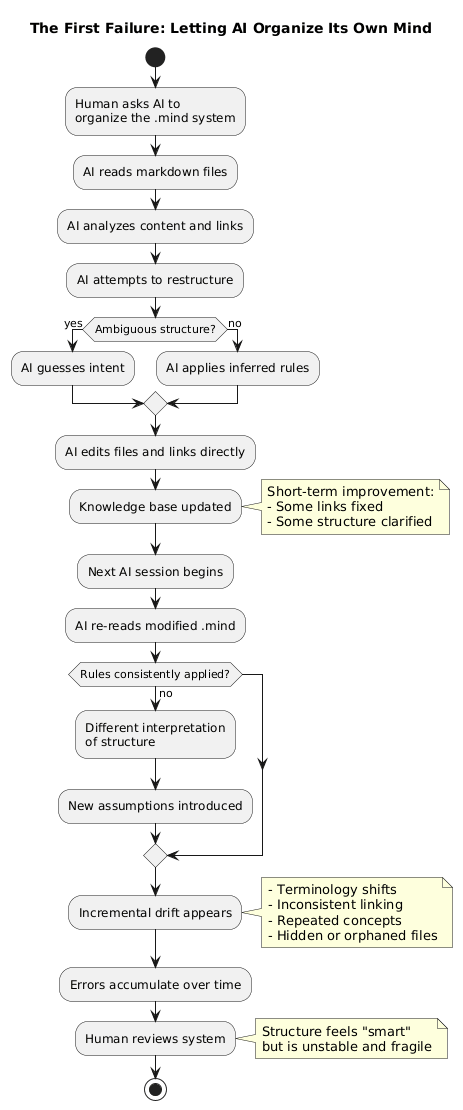
The First Failure: Letting AI Organize Its Own Mind
My initial instinct was simple and naive:
“Why don’t I let the AI organize the .mind files by itself?”
After all, AI is good at:
- summarizing
- categorizing
- connecting ideas
- recognizing patterns
So I tried.
I asked the AI to:
- reorganize files
- fix broken links
- unify structure
- clean inconsistencies
- improve navigation
And it partially worked — but only on the surface.
The deeper problems remained:
- Some links were fixed, others were guessed
- Files were moved, but long-term consistency broke later
- Terminology drifted again after a few sessions
- Small errors accumulated quietly
- The system felt “smart,” but not stable
The truth was uncomfortable:
AI is creative, but it is not reliable at hard, repetitive loops.
It gets tired.
It improvises.
It optimizes locally, not structurally.
I was asking the wrong thing from AI.
The Insight: AI Should Not Organize — It Should Observe
That’s when the shift happened.
I stopped asking AI to do the organization.
Instead, I asked:
What if AI only observed the mind —
and scripts did the hard work?
This changed everything.
Scripts Became the Skeleton of the Mind
I started writing simple, predictable scripts.
Not smart scripts.
Not “AI scripts.”
Just honest, boring, deterministic scripts.
Scripts that:
- scan files
- validate links
- detect encoding issues
- measure reachability
- count references
- report inconsistencies
- apply safe fixes when possible
They had no creativity.
No opinions.
No hallucinations.
And that was exactly their power.
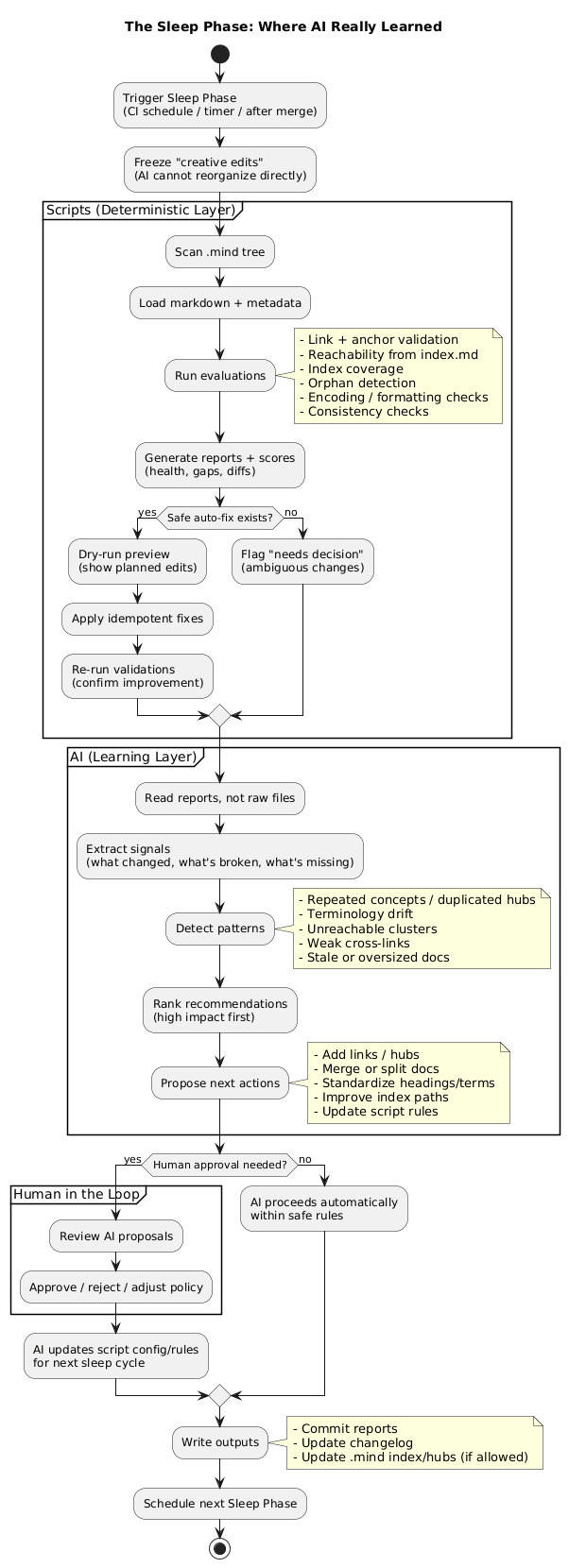
The Sleep Phase: Where AI Really Learned
Here’s the part that surprised me.
Once scripts existed, AI didn’t need to organize anymore.
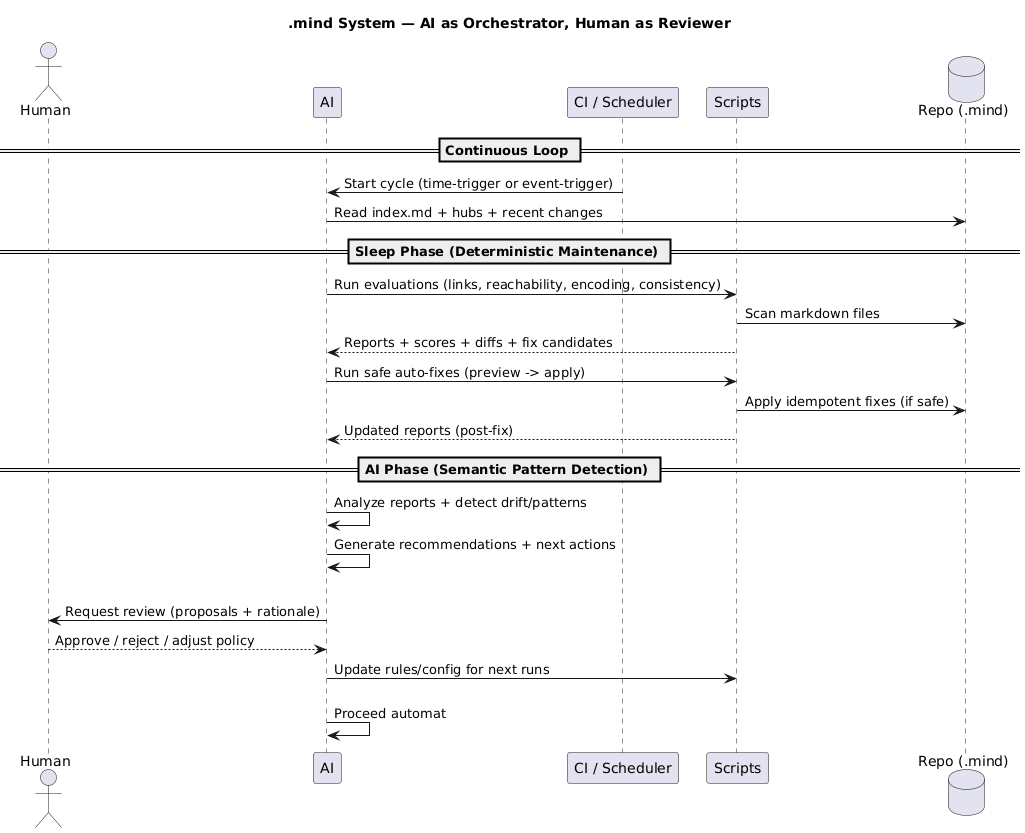
It only needed to read the reports.
This created something new:
A sleep phase for the AI.
During this phase:
- Scripts run first
- Reports are generated
- Metrics are exposed
- Patterns become visible
Then AI steps in — not to fix — but to detect patterns.
It notices:
- which documents are isolated
- which concepts repeat under different names
- where structure is weak
- which areas of the mind are growing too fast
- which parts are becoming stale
AI stops pushing files around and instead starts thinking.
The mind reorganizes itself through predictable rules,
while AI reflects on meaning and direction.
That separation was critical.
Why Scripts Create Mind Consistency (and AI Couldn’t)
Scripts succeed where AI fails for one simple reason:
Scripts do not get creative
They:
- run the same way every time
- never “assume” intent
- never skip steps
- never get bored
- never improvise
They handle:
- the hard loop
- the boring repetition
- the long-term maintenance
This creates structural gravity.
Once gravity exists, AI can orbit safely.
AI’s New Role: Pattern Detection, Not Maintenance
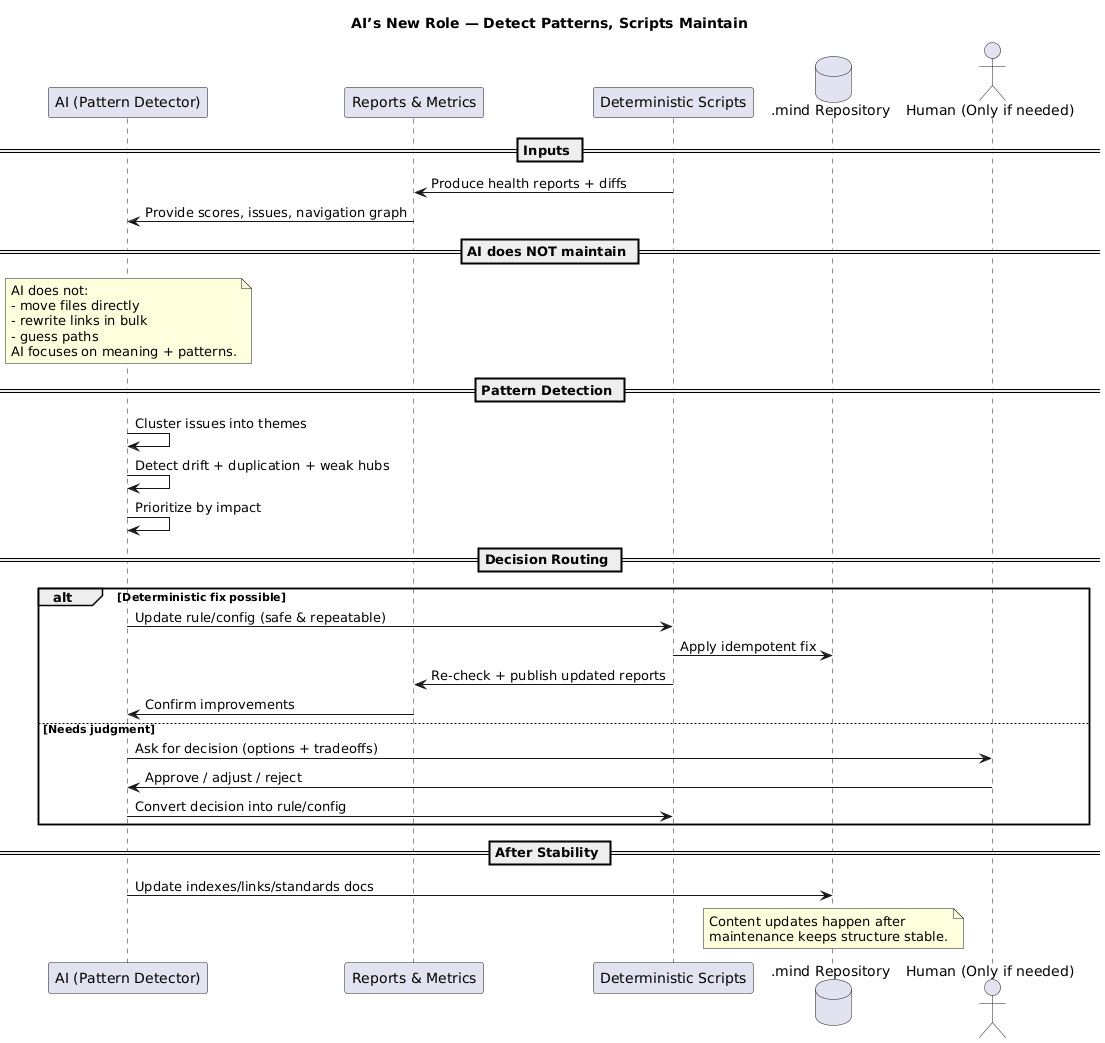
With scripts handling structure, AI became something else entirely:
- a pattern detector
- a system thinker
- a semantic observer
- a storyteller of the mind
AI no longer “fixes links.”
AI asks why links matter.
AI no longer “renames files.”
AI notices naming philosophies emerging.
AI no longer cleans chaos.
AI understands it.
This is when consistency truly emerged.
The Closed Loop Finally Closed
The workflow became natural:
- Humans write knowledge
- Scripts evaluate and maintain structure
- Reports expose the state of the mind
- AI analyzes patterns during the “sleep phase”
- Humans and AI update the .mind
- The cycle repeats
No heroics.
No manual policing.
No fragile intelligence.
Just evolution.
What the .mind Really Is (Now)
The .mind system is no longer just documentation.
It is:
- a shared memory
- a thinking surface
- a training ground for context
- a stable substrate for AI reasoning
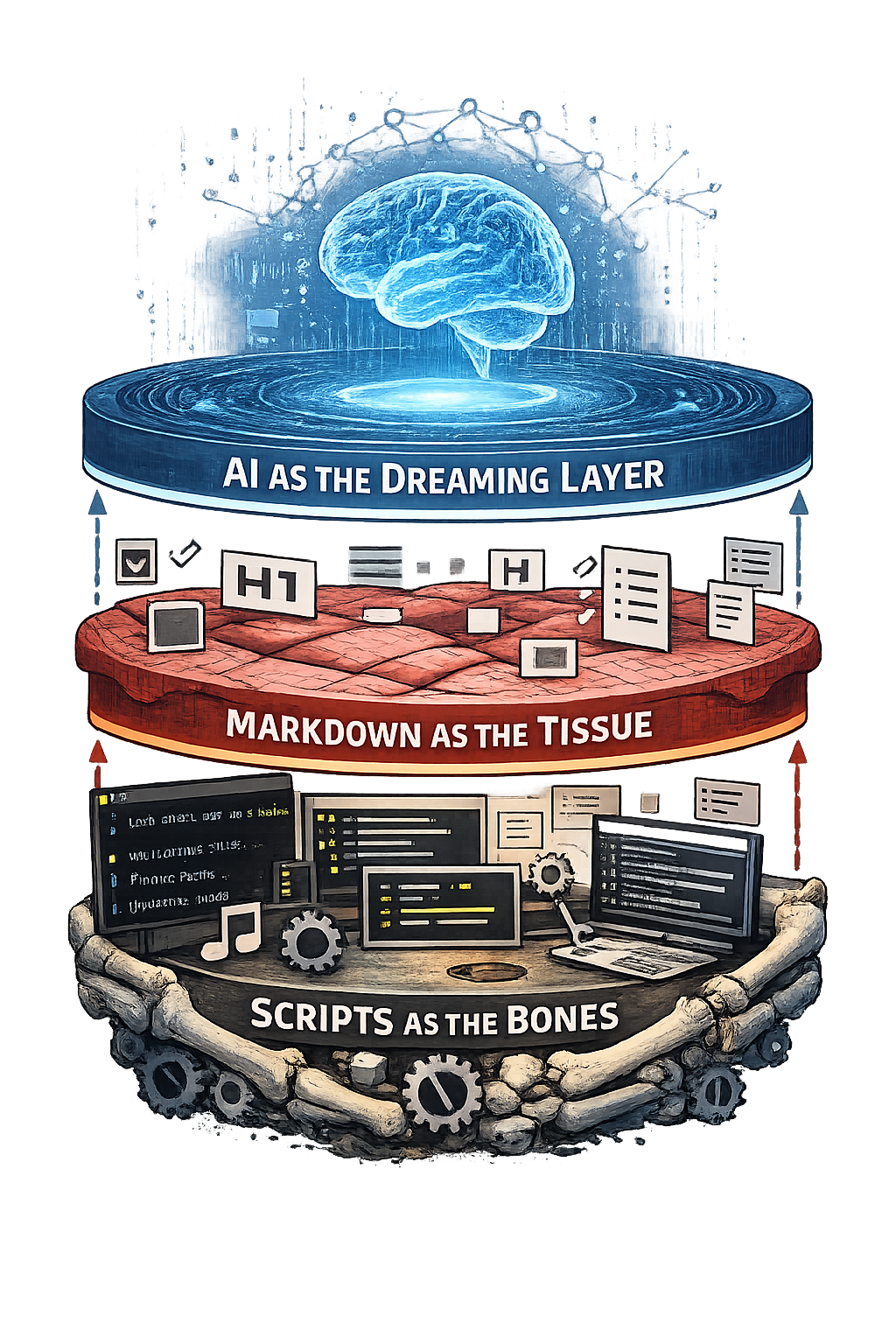
Scripts are the bones.
Markdown is the tissue.
AI is the dreaming layer.
A Lesson I Didn’t Expect
I thought the breakthrough would be a better prompt.
Or a smarter AI.
Instead, it was humility.
I learned to stop asking AI to be disciplined.
And instead:
- give it structure
- give it feedback
- let it think when the system is quiet
Intelligence doesn’t emerge from chaos.
It emerges from repetition plus reflection.
Scripts gave repetition.
AI gave reflection.
Together, they gave the mind consistency.

 RoofMan Official Blog
Pingback: The AI That Dreams in Markdown | RoofMan Official Blog