Optimizing Git for AI Workflows
Working with AI has changed how we write code.
You’re no longer just writing clean commits. You’re generating things constantly—logs, experiments, prompts, half-working scripts, weird debugging outputs, temporary tests… things that matter in the moment but don’t belong in your feature branch.
And Git… honestly, Git wasn’t designed for this kind of workflow.
At some point, you hit the same problems over and over:
- You switch branches and lose uncommitted work
- You stash things… then forget what’s inside
- You try to keep things clean, but end up deleting useful context
- Or worse—you pollute your feature branch with noise
I ran into this enough times that it became clear:
the problem isn’t Git—it’s the way we’re using it in an AI-driven workflow.
That’s where the idea of a Mirror Branch came in.
The Shift: Stop Fighting the Mess
AI work is messy by nature.
You explore. You iterate. You generate things that might work, might not. You debug with logs. You try different approaches. You keep notes. You tweak prompts.
This is not “clean commit” territory.
Trying to force this into a traditional Git flow is exhausting. You either:
- Over-clean (and lose context), or
- Over-commit (and destroy branch quality)
Neither works.
So instead of fighting the mess… just contain it.
The Mirror Branch Idea
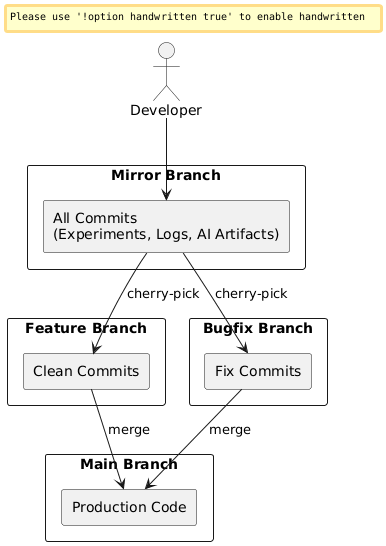
A Mirror Branch is simple:
It’s your personal space where everything goes, without judgment.
You create one branch just for yourself:
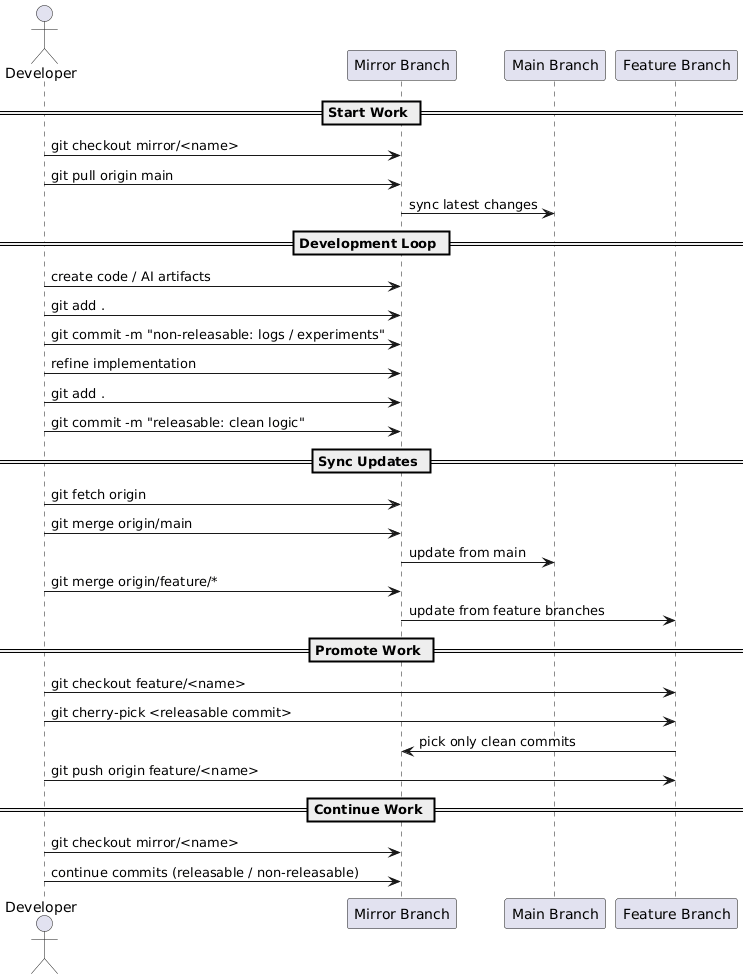
git checkout -b mirror/your-name
And from that moment, it becomes your real working branch.
Not your feature branch. Not your bugfix branch.
This is where you:
- Save AI outputs
- Keep logs
- Commit experiments
- Store temporary scripts
- Write notes and drafts
Nothing is “too messy” here.
What Changes in Your Workflow
Instead of trying to keep things clean while working… you separate two concerns:
- Exploration happens in the mirror branch
- Clean code gets promoted later
That’s it.
You don’t worry about whether something is “ready” or not.
You just commit it.
No More Stash Anxiety
Before this, I was using git stash all the time.
And it always turns into the same story:
- “I’ll stash this quickly…”
- “I’ll come back to it later…”
- “Wait… what was in stash 3 again?”
Stash is fine for quick switches, but it’s terrible for real work.
There’s no structure. No memory. No meaning.
With a mirror branch, you don’t stash.
You commit everything.
And suddenly, nothing gets lost.
Promoting Code the Right Way
When something actually becomes clean and releasable, then you move it.
You go to your feature branch:
git checkout feature/payment-status
And you cherry-pick only what matters:
git cherry-pick <commit>
That’s the key:
Your feature branch only sees what’s ready.
Your mirror branch keeps everything else.
No noise. No accidental commits. No regrets.
What Lives in the Mirror Branch?
Practically speaking, this is what ends up there:
- AI-generated code that’s not finalized
- Debug logs and traces
- Integration test scripts
- Temporary utilities
- Prompt experiments
- Draft documentation
- Failed ideas (which are often useful later)
And this is important:
Just because something isn’t releasable doesn’t mean it’s not valuable.
In fact, some of the best insights come from things that didn’t work.
The Unexpected Benefit: Memory
After using this for a while, something interesting happens.
Your mirror branch becomes more than a workspace.
It becomes a memory of your thinking.
You can go back and see:
- Why you changed direction
- What you tried before
- How the solution evolved
- What AI suggested at each step
This is something you completely lose with stash or deleted changes.
Keeping Your Main Branch Clean Without Stress
Before, “keeping things clean” required effort.
Now it’s automatic.
Because you never work directly in your feature branch, you don’t risk polluting it.
You only bring in what you intentionally choose.
And that small shift removes a lot of mental overhead.
Simple Rules That Make It Work
There’s no heavy process here. Just a few rules:
- One mirror branch per developer
- Never merge it into main
- Commit freely, without overthinking
- Cherry-pick only what’s ready
- Treat it like your personal development journal
That’s it.
When This Becomes Essential
You really feel the value of this approach when:
- You’re working heavily with AI tools
- You’re doing exploratory or research-based work
- You generate a lot of intermediate artifacts
- You switch contexts frequently
In those cases, this isn’t just helpful—it becomes necessary.
Final Thought
AI didn’t just change how we write code.
It changed what “working code” even means.
There’s now a layer of thinking, experimenting, and generating that sits before the final result.
The mistake is trying to force that layer into clean Git history.
The better approach is simple:
Keep everything. Publish selectively.
The Mirror Branch is just a practical way to do that—without losing your work, your context, or your sanity.

 RoofMan Official Blog