AI, Science & Faith: Seeing the Unseen

1. The Question That Started It All
As a computer engineer, I’ve always been fascinated by the space between abstract theory and tangible experience.
Few theories capture that gap more than string theory (Wikipedia), the ambitious framework suggesting that every particle and force is built from unimaginably small, vibrating strings.
At its heart lies the Polyakov Action (Wikipedia), a mathematical formulation describing how strings move through spacetime. Elegant on paper, it’s intimidating to visualize — and for most people, it stays locked as equations in a textbook.
One day, while studying string theory purely for fun, I asked myself:
“What does this actually look like?”
I decided to stop reading and start seeing.
2. From Equation to Browser
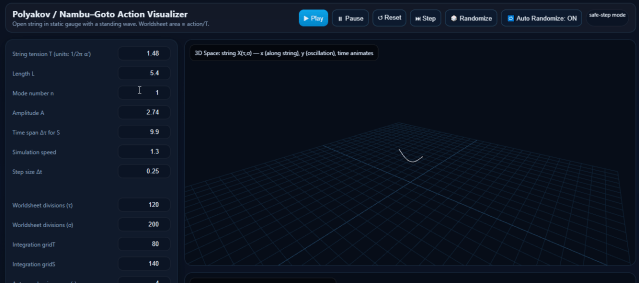
Instead of sketching diagrams or watching someone else’s lecture, I set out to visualize the Polyakov Action in 3D — live in a web browser.
To make it happen, I turned to AI coding assistance (GPT5). In just 5 hours, AI helped me:
- Write the base JavaScript and WebGL rendering code using Three.js
- Debug issues in real time
- Add parameter controls for tension, amplitude, and frequency
- Implement step-by-step rendering to avoid browser lock-ups
- Randomize parameters for different string behaviors
- Polish UI so it’s intuitive for anyone to explore
Without AI, this project would have taken me at least a month of solo work.
📌 Try the simulation now:
🔗 Polyakov Action Visualization
3. Why This Changes Learning
This experiment convinced me that AI is reshaping education:
- It compresses months of work into minutes.
- It allows concept-to-experiment transitions instantly.
- It makes complex physics interactive and accessible.
In my case, AI transformed string theory into a playground — you can see, adjust, and explore the mathematics for yourself without needing specialized software.
This is where the future of learning is headed: students won’t just consume theories — they’ll build and visualize them in real time.
4. AI as a New Frontier for Science and Faith
I believe AI can be a bridge — not just between humans and complex science, but between science and faith.
Historically, during the Islamic Golden Age (Wikipedia), scholars united rigorous scientific inquiry with spiritual belief, seeing no contradiction between studying nature and acknowledging its Creator.
Today, AI can revive that synthesis by making the hidden structures of nature visible to all — sparking both scientific curiosity and spiritual reflection.
When we see the elegance of physical laws, it’s easier to view them not as accidents, but as signs.
5. Power, Ownership, and Responsibility
I once heard Sam Harris (Wikipedia) say, “AI will be our God.” (TEDx-Lecture), I disagree.
AI is not God. It’s a tool. The morality and purpose it serves come from the human who wields it.
It can inspire creativity and innovation, but it can also be twisted into false gods — systems we worship blindly, mistaking human-made constructs for ultimate truth.
And here’s a point I want to emphasize:
If you want to truly control your AI, you must own its infrastructure.
6. A Final Reflection
After building and running my simulation, I was reminded of a verse from the Qur’an:
“سنريهم آياتنا في الآفاق فيعرفونا”
“We will show them Our signs in the horizons so they will know Us.” (Quran.com)
To me, science — even in theoretical forms like string theory — is part of those signs.
I believe in Allah (All-Mighty) as the Creator of all things. While Michio Kaku (Wikipedia) may speak of “Mother Nature,” I see these discoveries as glimpses into the work of the One who designed it all.
In the end, AI didn’t just help me code — it helped me see. And in seeing, it deepened my technical knowledge and my appreciation for the Creator’s design.

 RoofMan Official Blog