
Building a Private Cloud: Overcoming the Bottleneck

Have you ever imagined building your own private cloud from scratch? That’s exactly what I set out to do. So, I rolled up my sleeves, turned my home into a mini data center, and embarked on a mission to create a private, micro-scale cloud that combines computing and storage power. Why? Because it’s not just about the cool factor—it’s about scaling operations, mastering IT and cybersecurity, and, of course, keeping my data safe from the ever-watchful Skynet.

However, I quickly realized that the main threat to this project is connectivity—ensuring stable and sufficient bandwidth is essential for making such a setup practical and reliable. I needed to handle both outbound and inbound connectivity scaling to make this feasible. Intrigued? Let’s discuss the theory of the solution, but first, let’s define the problem.
The Problem: Internet Speeds That Make You Weep

Let’s face it—the cloud is ridiculously fast. Commercial cloud providers spoil us with 10Gb/s bandwidth, while at home, we’re stuck with whatever our ISPs graciously throw our way. For me, that was a measly 70Mb/s ADSL (Asymmetric Digital Subscriber Line) with a download-to-upload speed ratio of 10:1, a type of internet connection that uses traditional telephone lines but offers limited upload and download speeds compared to modern fiber connections. Imagine trying to run a business or enabling remote work for a team with such speeds. Spoiler alert: it’s like watching paint dry.

Sure, you could say, “Just go to the cloud.” But where’s the fun in that? Plus, there’s the joy of learning, the satisfaction of saying you built it yourself, and the added layer of security from controlling your own infrastructure.
Meet MPTCP: The Bandwidth Supercharger

MPTCP, or MultiPath TCP, acts as a powerful digital orchestrator for your internet connections, seamlessly combining bandwidth from multiple sources into a unified, high-speed pipeline. Whether it’s a landline, satellite, or wireless connection, MPTCP leverages them all to boost overall performance. For instance, your sluggish 70Mb/s ADSL connection can join forces with your satellite and wireless networks to create a significantly faster and more reliable connection.


Here’s why it’s transformative:
- Aggregation: MPTCP splits your data into packets and sends them across multiple paths simultaneously, optimizing speed and reliability.
- Redundancy: If one connection fails or experiences issues, the others ensure uninterrupted service.
- Load Balancing: Traffic is managed across all available connections, preventing any single line from becoming overloaded and maintaining efficient performance.
In essence, MPTCP reimagines connectivity by uniting diverse sources into a cohesive powerhouse. But it’s not just about boosting speed; it’s about fundamentally changing how connections work together to overcome limitations.
When it comes to outbound traffic, MPTCP excels by sending packets simultaneously across all connections, resulting in a significant speed boost. The intelligent load balancing further ensures no single line bears the brunt of your internet usage.
While this setup solves many issues, I soon realized another challenge: managing inbound traffic effectively.
The Challenge of Scaling Inbound Traffic
Outbound traffic is great, but what about inbound? Accessing a private cloud from anywhere—securely and with the same aggregated speed as outbound—posed a significant challenge. Typically, inbound traffic must come from a single IP address and be received by your edge router, which also has a single IP address. This setup means routing through one device or line with low speed, creating a bottleneck that can negate the advantages of aggregation. To address this, I needed a solution that connected inbound traffic over the same virtual aggregated line created for outbound traffic.

By leveraging hybrid cloud architecture, site-to-site VPNs, and MPTCP, I was able to build a VPN entry point in a low-cost cloud site. This entry point linked with my on-premises site via MPTCP. This setup allowed the cloud site users to access the on-premises infrastructure through the same aggregated virtual line. Additionally, the aggregation capabilities of MPTCP alongside the encryption and secure tunneling of VPNs created a robust and aggregated pipe for inbound traffic. This ensures high-speed, secure access to my infrastructure from any location. It wasn’t just a theoretical concept; I implemented the solution, ran extensive tests over two months, and achieved excellent results.
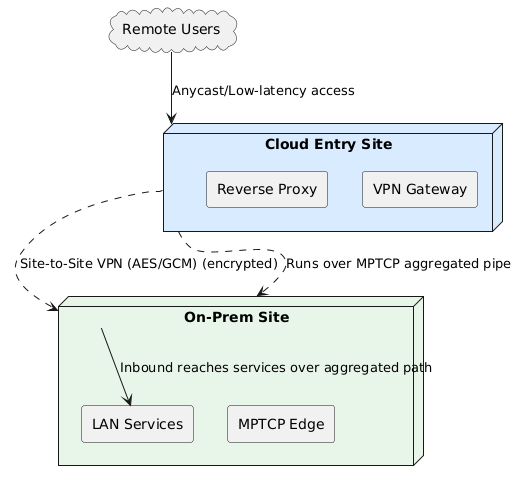
Of course, there were a few challenges along the way. Connectivity issues occasionally arose due to the complexities of integrating multiple network components. To address this, I developed monitoring scripts that performed periodic connectivity checks and implemented automatic re-routing mechanisms. These proactive measures minimized disruptions and ensured smooth, reliable operations.
FrontLink: Scalable and Secure Connectivity
I named this project FrontLink, as it represents the seamless combination of VPN over MPTCP to achieve scalability and security. Here’s what I accomplished:
- Scalability: Using FrontLink, I successfully scaled up my on-premises network capabilities, enabling it to handle increased traffic and workloads with ease.
- Enhanced Security: My data remains secure, with a reduced internet footprint because traffic is distributed across multiple sources, making it difficult to trace or disrupt.
- Learning Opportunities: This project has been an invaluable experience for mastering networking, IT infrastructure, and cybersecurity. Who needs textbooks when your home lab offers hands-on learning?

(Blue/Cloud – Green/OnPrem)
Why I’m Sharing This

This project started as a personal challenge—a research endeavor to see if I could pull off what many would deem impossible for a home setup. While I won’t be releasing detailed implementation guides to avoid helping in abuse of my design, such as using it for unauthorized network access or other malicious purposes, I wanted to confirm that the theory works. And it does.
If you’re thinking about building your own private cloud, don’t let the limitations of home internet deter you. With a bit of creativity, some networking know-how, and the magic of MPTCP, you can create something that’s not only functional but also incredibly satisfying.
So go ahead, build, experiment, and most importantly, have fun. Who says the cloud is only for the big guys? Not me.

 RoofMan Official Blog
Pingback: Avoiding TCP-over-TCP Meltdown in WANs | RoofMan Official Blog
Pingback: Rethinking Connectivity for a Micro Data Center | RoofMan Official Blog
Pingback: GhostMachine: My Private Network in a Public World | RoofMan Official Blog